


ABDOMINAL BRAIN An Integrative Osteopathic Approach and Its Impact on the Brain–Gut–Pelvis Axis. Nathalie Camirand, D.O.
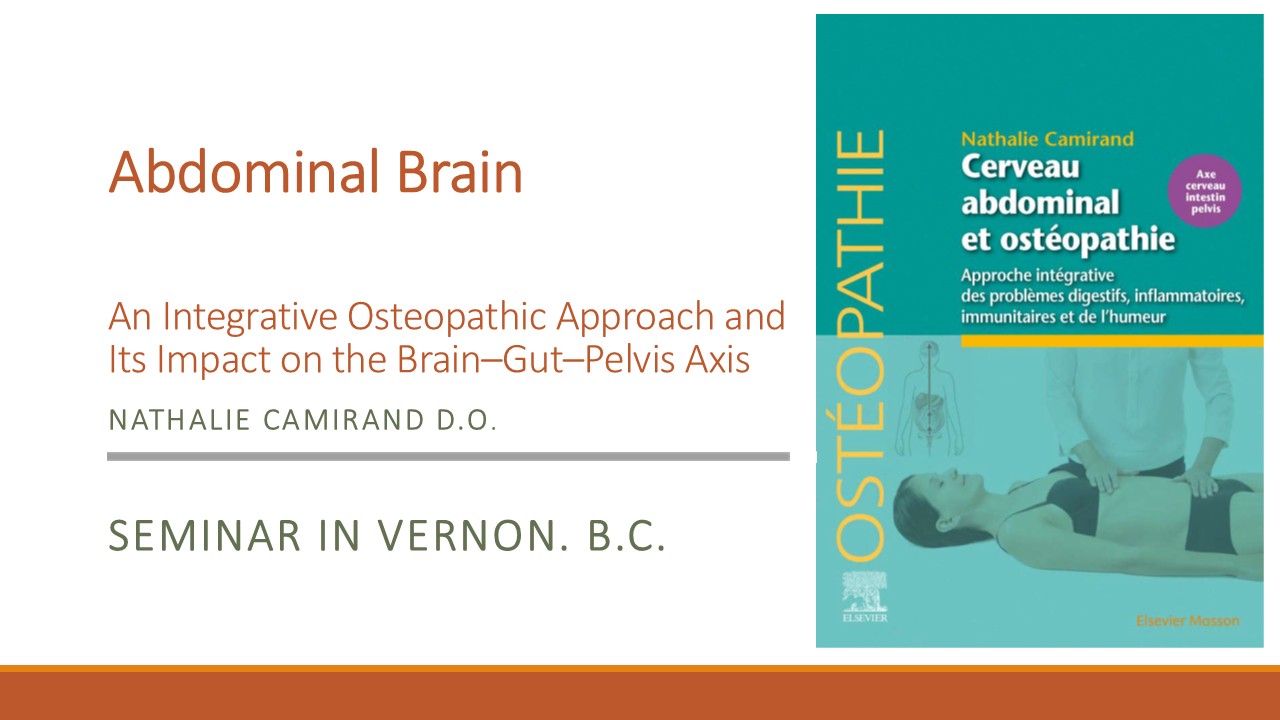
ABDOMINAL BRAIN An Integrative Osteopathic Approach and Its Impact on the Brain–Gut–Pelvis Axis. Nathalie Camirand, D.O.
Practical course over 3 days, June 26-27-28, 2026
A 4,5 hour theoretical training course, accessible via video and to be completed at your own pace before the seminar.
The practical component will also include theoretical input directly related to clinical practice.
Training format
• Theoretical component: 4.5 hours (online, prerequisite)
• In-person seminar: 3 days, 21 hours
• Schedule: 9:00 a.m. to 5:30 p.m.
• Language: English
• Target audience: licensed osteopaths
Training description
This seminar offers an in-depth exploration of the osteopathic approach to the gastrointestinal system considered as the “abdominal brain,” as well as its involvement in gynecological, inflammatory and mood disorders. It aims to develop an integrative understanding of the interactions between the digestive, nervous and immune systems.
Participants will acquire advanced and targeted visceral techniques, as well as specific techniques applied to the vagus nerve, recognized for its central role in digestive regulation and neuro-immune interactions. Particular attention will also be given to the approach to the vascular structures of the digestive system, through the learning of precise methods of assessment and treatment.
The training addresses in depth various clinical conditions, including intestinal permeability, functional bowel disorders and digestive imbalances. The entire gastrointestinal system is studied, from the oral cavity to the rectum, including often under-recognized dysfunctions such as gastroparesis, biliary disorders, enzymatic deficiencies, as well as microbiome imbalances (bacteria and parasites). The impact of these imbalances on the nervous, immune and gynecological systems is also analyzed.
An important clinical emphasis is placed on palpatory evaluation, allowing the identification of certain food intolerances and microbiotal imbalances, as well as understanding their physiological implications.
This training aims to provide participants with concrete clinical tools to integrate these concepts into their practice, in order to optimize the management of digestive disorders within a global and integrative osteopathic perspective.
Training objectives
At the end of the training, the participant will be able to:
• Understand the interactions between the abdominal brain, the pelvic brain, the nervous system and the immune system within an integrative approach based on the brain–gut–pelvis axis
• Identify the main dysfunctions of the gastrointestinal system and their systemic impacts
• Perform an osteopathic clinical evaluation of the digestive system
• Apply specific osteopathic techniques adapted to different dysfunctions
• Integrate a global clinical approach into their practice
Specific objectives – theoretical component (online)
At the end of the theoretical component, the participant will be able to:
• Understand the foundations of the brain–gut–pelvis axis
• Explain the interactions between the digestive, nervous and immune systems
• Describe the role of the enteric nervous system and the microbiota
• Understand intestinal permeability, its triggering factors and its impacts
• Clarify the phases of hepatic detoxification
• Identify the main digestive dysfunctions and their impacts
• Integrate the physiopathological bases necessary for clinical evaluation
Specific objectives – practical component (in-person)
At the end of the practical component, the participant will be able to:
• Determine which component of the brain–gut–pelvis axis to address first in order to avoid rebound effects
• Perform a complete osteopathic evaluation of the digestive system
• Identify areas of dysfunction through palpation
• Suspect microbiotal disorders (SIBO, SIFO), the presence of allergens and parasites
• Apply specific visceral techniques
• Integrate arterial and vagal approaches
• Adapt clinical reasoning to different situations
Training plan
Theoretical component (online – prerequisite)
Module 1 – Brain–Gut–Pelvis Axis
• Definition and interactions of the three brains
• Communication pathways
• Osteopathic perspective
Module 2 – Abdominal Brain
• Definition and organization
• Enteric nervous system
• Endocrine and immune functions
Module 3 – Digestive Ecosystem
• Mucosa, serosa, immunity
• Microbiota (SIBO, SIFO)
• Digestive and immune impact
Module 4 – Dysfunctions
• Intestinal permeability
• Digestive disorders
• Hepatic detoxification
• Inflammation and mood
In-person training plan
Day 1 – Global assessment
AM
• Postural observation
• Spine, sacrum, coccyx
• Diaphragm
• Global sphere testing
• Intestinal palpation
PM
• Abdominal brain approach
• Diaphragm / visceral techniques
• Mesenteric tension
• Drainage
• Global evaluation
Day 2 – Digestive dysfunctions
AM (supramesocolic)
• Stomach, esophagus, pylorus
• Duodenum, pancreas
• Gallbladder
PM (inframesocolic)
• Colon
• Mesentery
• Constipation
• Pelvic floor
Day 3 – Integration
AM
• Arterial approach
• Aorta, celiac trunk, mesenteric arteries
PM
• Vagal approach
• Clinical integration
• Case-based practice
Teaching methods
• Theoretical lectures
• Demonstrations
• Supervised practice
• Case studies
• Clinical discussions
Assessment methods
Assessment is based on a continuous formative approach:
• Observation during practice
• Active participation
• Integration of concepts
• Quality of techniques performed
Ongoing feedback is provided throughout the training to support learning
A seminar not to be missed!
Biography

NATHALIE CAMIRAND, D.O.
Nathalie Camirand holds a degree in Physiotherapy from the University of Montreal and a diploma in Osteopathy from the Collège d’Études Ostéopathiques (CEO) of Montreal. She is also a certified naturopath (Québec).With over 25 years of experience as an international lecturer and speaker, she taught at the CEO of Montreal from 1993 to 2019 and has delivered continuing education programs for more than two decades in the fields of Gynecology, Urology, Glandular Dysfunctions, Anxiety and Depression in relation to the Brain–Gut Axis, and Women’s Health.
She has taught extensively across Canada, South America and Europe, presenting in more than 15 countries. From 2017 to 2018, she coordinated a 30-credit post Master degree University Diploma of Specialization in Gynecology–Obstetrics at Pompeu Fabra University in Barcelona, in collaboration with the EOB (Escuela de Osteopatía de Barcelona).
She is co-owner of the Clinique Camirand Muzzi and co-founder of the Institut Camirand Muzzi, a postgraduate continuing education institute based in Montreal.
She is the author of four books also translated in other languages (German and Polish):
- Glandular and Nervous Dysfunctions (Maloine, 2009), translated into three languages
- Brain–Gut–Pelvis Axis and Osteopathy: An Integrative Approach to Stress, Anxiety and Depression (Elsevier, 2019), translated into German
- Abdominal Brain and Osteopathy: An Integrative Approach to Digestive, Inflammatory, Immune and Mood Disorders (Elsevier, 2022), translated into German
- Pelvic Brain and Osteopathy: Brain–Gut–Pelvis Axis – An Integrative Approach to Urogynecological Dysfunctions and Pathologies (Elsevier, 2025), forthcoming German translation
In 2019, she was awarded the Prix Reconnaissance Ostéopathie Québec in recognition of her contribution to the advancement of osteopathy.
Information sur l'achat
Organisateur