


ABDOMINAL BRAIN An Integrative Osteopathic Approach and Its Impact on the Brain–Gut–Pelvis Axis. Nathalie Camirand, D.O.
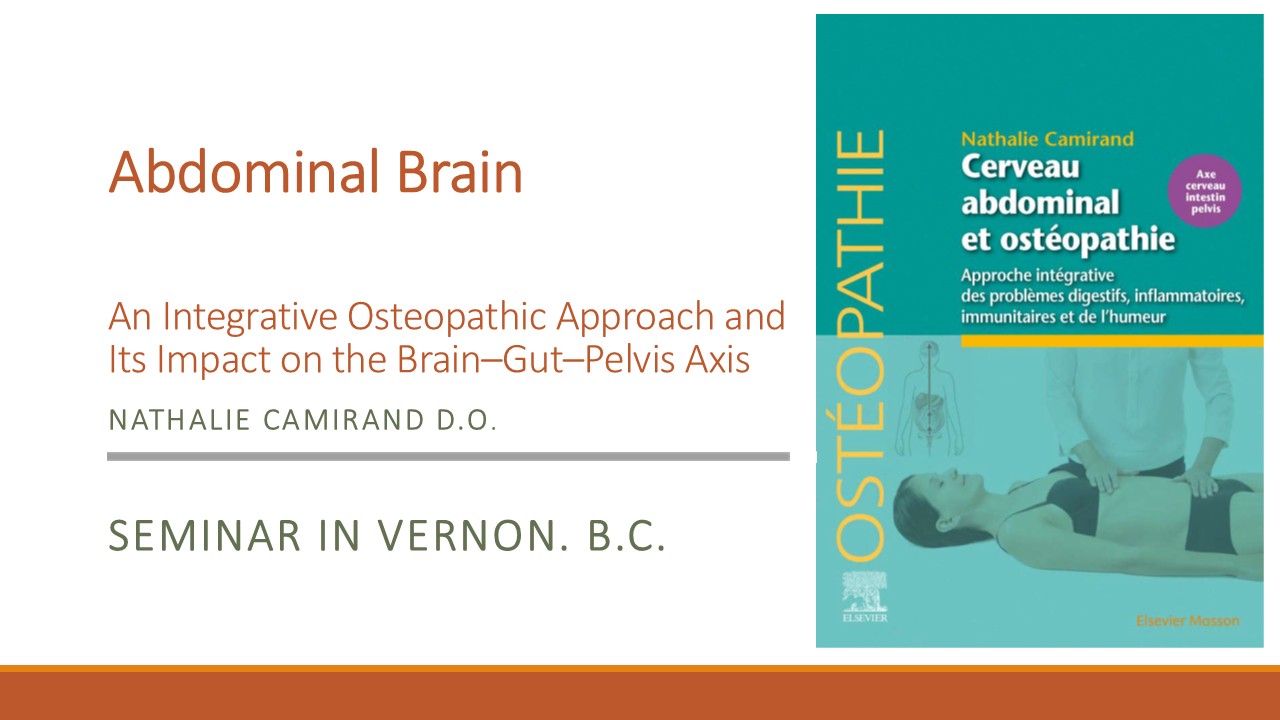
ABDOMINAL BRAIN An Integrative Osteopathic Approach and Its Impact on the Brain–Gut–Pelvis Axis. Nathalie Camirand, D.O.
Practical course over 3 days, June 26-27-28, 2026
A 4,5 hour theoretical training course, accessible via video and to be completed at your own pace before the seminar.
The practical component will also include theoretical input directly related to clinical practice.
This seminar invites you to discover the osteopathic approach to the gastrointestinal system as the « abdominal brain » and its role in the development of gynecological, inflammatory and mood disorders. You will learn advanced and targeted visceral techniques and specific techniques for the vagus nerve, which plays a crucial role in digestive regulation as well as the nervous and immune systems. This seminar will also introduce you to precise methods for adressing the arteries of the entire digestive system.
Disorders such as intestinal permeability, colopathies, and digestive imbalances will be explored in depth, providing you with a comprehensive understanding to optimize your therapeutic interventions. The seminar will cover the entire digestive system, from the mouth to the anus, including often overlooked dysfunctions such as gastroparesis, biliary disorders, enzyme deficiencies, and imbalances in the microbiome (bacteria and parasites) and their impact on the nervous, immune, and gynecological systems. You will also learn how to detect food intolerances and parasites through palpation, understanding their impact on the nervous and immune systems.
This innovative and informative seminar will provide you with practical tools to address digestive disorders from an integrative osteopathic perspective, enabling you to better understand and treat a wide range of dysfunctions related to these interconnected systems.
Course Objectives:
- Understand the interactions between the abdominal brain, the encephalon, the pelvic brain, the nervous system, and the immune system.
- Master specific osteopathic techniques to treat digestive, inflammatory, immune, and mood disorders.
- Optimize the assessment and treatment of gastrointestinal dysfunctions through palpation, visceral manipulations, and the manipulation of arteries and the vagal component of the digestive system.
- Prevent mood disorders and systemic inflammation through targeted interventions on the digestive system.
Theoretical Program : 4,5 hour video to watch at your own pace for the theory 3 weeks previously to the seminar venue :
- B-G-P Axis: Definition and interactions of the three brains
- Communication pathways between the abdominal brain and the nervous system
- Abdominal brain: Definition and organization of the enteric nervous system, gut immune ecosystem
- Microbiome and its impact on digestion and immunity. SIBO, SIFO.
- Intestinal porosity and its consequences
- Irritable bowel syndrome (IBS), gastroesophageal reflux, gastroparesis
- Pancreatic enzyme deficiency and atypical swallowing
- Spleen: Role in immunity and digestion
- Liver: Detoxification process (4 phases)
- Methylation and oxidative stress
General Practical Program:
- Postural observation and evaluation of the sacrum, coccyx, and spine, links with the digestive tract
- Examination of the supramesocolic and submesocolic areas
- Drainage of the peritoneum and digestive organs
- Palpation techniques and normalization of the digestive system, including the spleen, liver, gallbladder, stomach, pancreas, intestines, and their attachments
- Arterial approach to the abdominal brain: Arteries of the abdominal aorta, celiac trunk, mesenteric arteries, and iliac arteries
- Vagus nerve techniques: Testing the vagal component of various plexuses and sections of the digestive system
Detailed Practical Program:
- Postural observation
- Sacrum and sacral dura mater
- Coccyx, internal and external terminal filum
- Spine and impressions
- Sphere testing : Where to start to balance in regard to the B-G-P axis
- Diaphragm and pillars: Approach to the subdiaphragmatic abdominal brain
- Examination of the entire digestive system
- Spleen vs diaphragm, spleen/stomach and other joints
- Liver recoil vs attachment to diaphragm. Left lobe/heart
- Liver parenchyma
- Lesser omentum
- Stomach
- Test for stomach descent capacity
- Esophagus cervical and thoracic sections: Global test for cervical and thoracic regions, then narrowing zones
- Fundus (spasm and distention injury)
- Body, fundus, and antrum (contraction-relaxation capacity, distension injury). Gastroparesis
- Pylorus + vagal component test
- Duodenum 1-2-3 (distension or spasm?): Test and techniques
- Pancreatic head
- Gallbladder, common bile duct, and sphincter of Oddi
Submesocolic Approach:
- Palpation of the intestines: Diagnostic tests for intolerances, parasites, emotional stress, toxicity, inhibition vs uterus
- Drainage of the peritoneum, enteric drainage, portal vein
- Mesenteric clamp
- Mechanical assessment of the entire colon: Valve, ascending, transverse, descending angles, spasm, distension
- Mesenteric root in 4 stages
- Arterial approach to the abdominal brain: Arteries of the abdominal aorta, celiac trunk, superior and inferior mesenteric arteries
- Celiac trunk
- Gastric arteries
- Superior and inferior mesenteric arteries and their branches
- Internal and external iliac arteries
- Rectal arteries and pelvic floor
- Vagal component test of the various plexuses and segments of the digestive system.
A seminar not to be missed!
Biography

NATHALIE CAMIRAND, D.O.
Nathalie Camirand holds a degree in Physiotherapy from the University of Montreal and a diploma in Osteopathy from the Collège d’Études Ostéopathiques (CEO) of Montreal. She is also a certified naturopath (Québec).With over 25 years of experience as an international lecturer and speaker, she taught at the CEO of Montreal from 1993 to 2019 and has delivered continuing education programs for more than two decades in the fields of Gynecology, Urology, Glandular Dysfunctions, Anxiety and Depression in relation to the Brain–Gut Axis, and Women’s Health.
She has taught extensively across Canada, South America and Europe, presenting in more than 15 countries. From 2017 to 2018, she coordinated a 30-credit post Master degree University Diploma of Specialization in Gynecology–Obstetrics at Pompeu Fabra University in Barcelona, in collaboration with the EOB (Escuela de Osteopatía de Barcelona).
She is co-owner of the Clinique Camirand Muzzi and co-founder of the Institut Camirand Muzzi, a postgraduate continuing education institute based in Montreal.
She is the author of four books also translated in other languages (German and Polish):
- Glandular and Nervous Dysfunctions (Maloine, 2009), translated into three languages
- Brain–Gut–Pelvis Axis and Osteopathy: An Integrative Approach to Stress, Anxiety and Depression (Elsevier, 2019), translated into German
- Abdominal Brain and Osteopathy: An Integrative Approach to Digestive, Inflammatory, Immune and Mood Disorders (Elsevier, 2022), translated into German
- Pelvic Brain and Osteopathy: Brain–Gut–Pelvis Axis – An Integrative Approach to Urogynecological Dysfunctions and Pathologies (Elsevier, 2025), forthcoming German translation
In 2019, she was awarded the Prix Reconnaissance Ostéopathie Québec in recognition of her contribution to the advancement of osteopathy.
Information sur l'achat
Organisateur